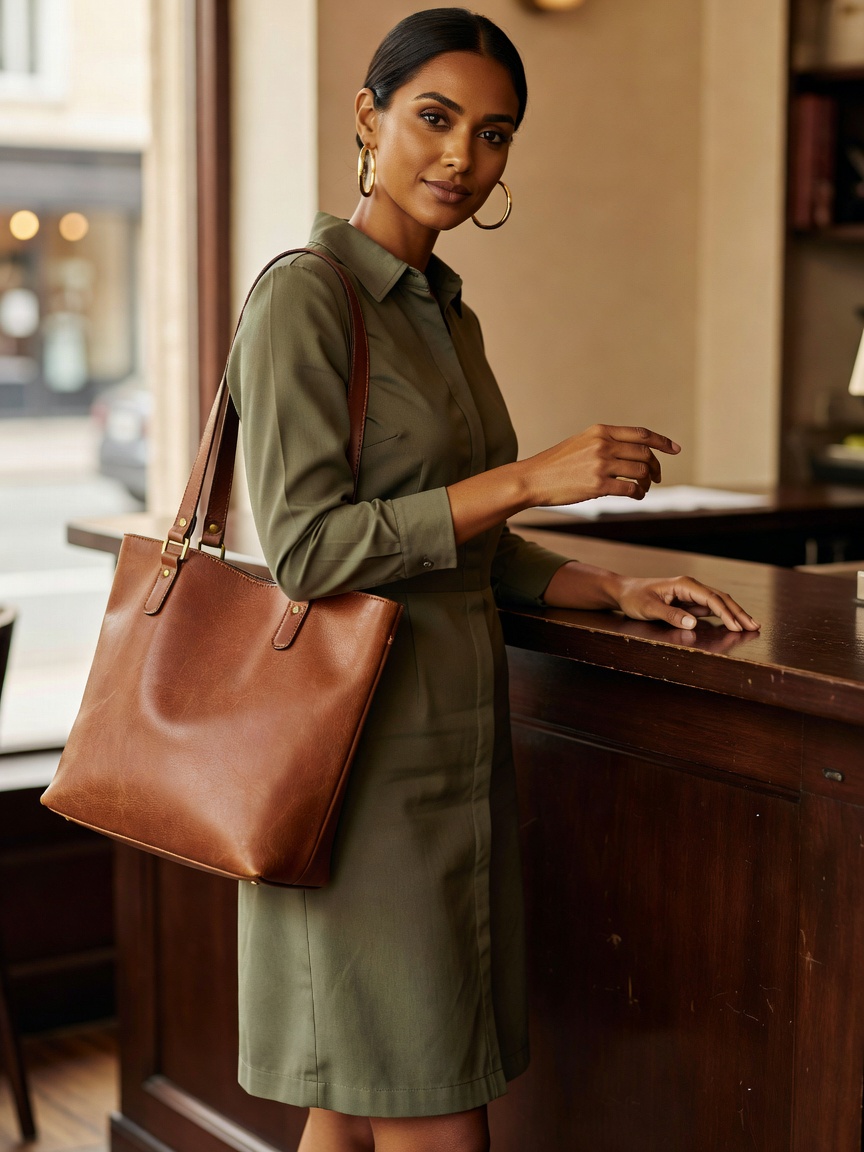
People read outfits quickly, and they mostly read the edges: what is on your feet, what is in your hand, what is happening at your collar and wrists. That is good news for anyone moving between settings, because the edges are exactly the parts that can change in thirty seconds in a station toilet or a café queue.
This guide breaks those edges down and shows how each one shifts the mood of an otherwise identical outfit. None of it requires spending money; most of it starts with things already in a drawer.
The one-swap rule
Our most-used principle is simple: when the setting changes, change one detail, not the whole outfit. A single deliberate swap tells people you made a choice for this moment. Two or three swaps start to feel like a costume change, and carrying them becomes a logistical problem.
Here is how one base outfit — dark straight trousers, an ecru knit and white leather trainers — reads across a day with a single change each time:
- Morning commute — add a cap and a crossbody bagPractical, hands free, weather-ready. Nobody reads it as "dressed up".
- Office — swap the crossbody for a structured toteThe same clothes now read organised and deliberate. Laptop and charger fit.
- Client lunch — add a slim watch or a fine chainSmall metal at the wrist or neck catches the eye across a table and signals care.
- Evening drinks — swap trainers for loafers or low heelsFootwear carries the most weight. Change it and the whole outfit shifts register.
Footwear: the loudest detail
Shoes cover a small area but carry an outsized share of the message, because they set the outfit's relationship to the ground — and to how fast you plan to move. Clean leather trainers sit comfortably in many offices; a loafer or derby reads more formal without needing a suit; a sandal immediately reads off-duty. Because shoes are also where comfort fails first, a sensible approach is to wear the shoes your longest walk demands and carry a lighter, flatter swap if needed.
Bags: function first, message second
The bag is the only accessory with a job description. Before considering style, list what it must carry on your busiest day. A structured tote with a flat base reads professional and holds a laptop; a soft canvas tote reads relaxed and holds groceries; a crossbody or sling keeps hands free on bikes and crowded platforms. Many readers keep a small pouch inside a large tote — the pouch becomes the evening bag when the tote is stashed under a desk or in a locker.
Collars, cuffs and the art of adjustment
Some of the most useful details are not objects at all. A shirt buttoned to the top reads sharp and contemporary; one button open reads relaxed; two reads evening. Sleeves rolled to the forearm signal work in progress — useful at a café table, less so in a formal meeting. Tucking, half-tucking or leaving a shirt loose changes the waistline and the mood in seconds. These adjustments cost nothing and need no carrying.

Jewellery, watches and eyewear
Metal near the face and hands draws attention to where conversation happens. A pair of small hoops or studs, a ring, or a watch on a leather or metal strap can make basic clothes look considered. Eyewear works the same way: a heavier acetate frame reads more editorial than a thin metal one. If you wear glasses daily, your frames are already one of your most visible accessories — treat them as part of the outfit plan rather than a separate decision.
Scarves and outer accents
A scarf is weather protection that doubles as a colour accent. In cooler months, a wool or cashmere-blend scarf adds warmth on the commute and, worn loosely indoors, softens a structured jacket. In summer, a lightweight cotton or silk square tied at the neck or on a bag strap adds colour without adding heat.
Where to go next
Details work best when the base outfit is versatile. See how to build that base across seven days in A Week Without Costume Changes, or bring us your own situation through the scenario tool.