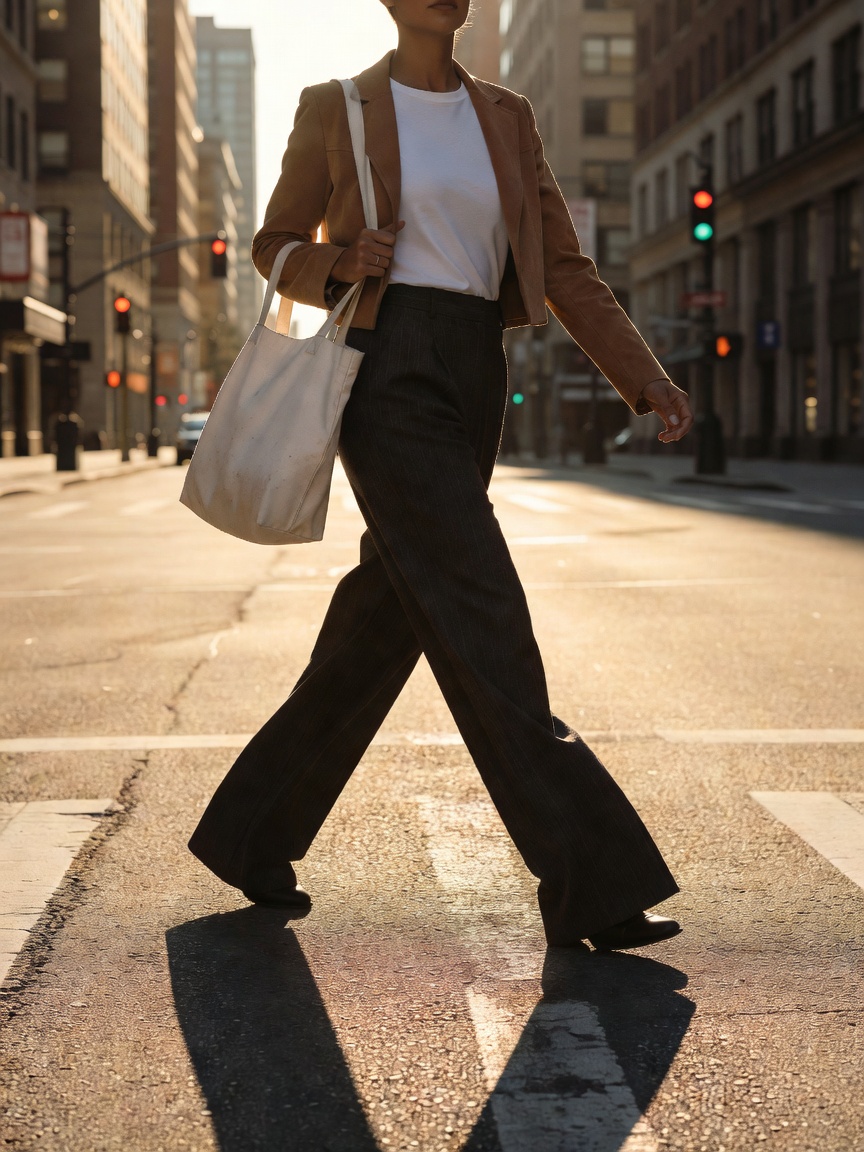
Every outfit has a shape before it has a colour. It is the outline you would see in silhouette against a window: where it is wide, where it narrows, where it stops. That outline decides more about comfort and usefulness than any trend report. A shape that looks right standing in a fitting room can fail completely on a forty-minute bus ride or a three-hour workshop on low café stools.
So instead of asking "what suits me?", this guide asks "what does this setting require my clothes to do?" The answers differ more than you might expect, and they rarely line up neatly with the categories shops use, like "workwear" or "weekend".
The three proportions that do most of the work
Most contemporary outfits can be read through three relationships. Getting these right covers the majority of situations.
- Top length against riseWhere the top layer ends relative to the trouser or skirt waistband. A cropped jacket over a high rise lengthens the leg; a hip-length shirt over a low rise shortens it. Neither is wrong, but each changes how much fabric bunches when you sit.
- Volume on top versus volume belowOne generous element, one controlled element is the most reliable balance. A wide trouser with a closer-fitting knit, or a roomy overshirt with a straight leg. Volume everywhere works too, but only in fabrics with drape.
- Where the hem meets the shoeTrouser break and skirt length decide whether an outfit looks finished at the bottom — and whether it survives puddles, bike chains and escalators.
Shape, setting by setting
The commute
Commuting rewards freedom at the shoulder and the knee. If you cycle — as roughly half of Copenhagen's commuters famously do — a slim, cropped or ankle-length trouser stays clear of the chain, and a jacket cut slightly longer at the back covers you when you lean forward. On rail systems like the London Underground or the Paris Métro, where you stand and reach, raise your arms in the fitting room. If the coat pulls across the back or the shirt untucks, it will do so every morning.
Long coats are the commute's best friend in winter, but only to mid-calf. Any longer and the hem catches on stairs and train doors.
The shared desk
Desk days are about the seated silhouette. Seated, the waistband carries most of the strain, and a rise that sits comfortably when standing can dig in after an hour. Mid to high rises with a little ease at the hip tend to fare better. Trousers should be long enough that sitting does not expose the shin; a full break or a wide leg that touches the shoe top usually does it.
On top, aim for a shape you can adjust without leaving the desk: a cardigan, an unstructured blazer, an overshirt. Hot-desking floors often run cool by the windows and warm by the meeting rooms, and a removable layer is the simplest form of climate control you own.
The café or remote day
Café tables are low, chairs are small and you spend a lot of time leaning forward over a laptop. Very short tops ride up; very long tunics bunch in the lap. A mid-hip length with a soft, relaxed shoulder works best. Sleeves that can be pushed to the forearm matter more here than anywhere: they keep cuffs out of coffee and off the trackpad.
The evening
Evening settings are usually standing settings — a gallery opening, a bar, a friend's kitchen. That is the moment to use more defined shapes: a belted waist, a sharper shoulder, a straight skirt. You will not be sitting cross-legged in it for three hours, so a little structure is affordable.

A quick fitting-room test
Before keeping something, try five movements: sit on a low chair, raise both arms as if holding a rail, climb a step, lift a bag onto your shoulder, and bend to tie a lace. Watch where the garment pulls, gapes or rides. Those points tell you which settings it will fail in. A trouser that strains when you sit is a standing-only trouser, which may be fine — as long as you know.
Where to go next
Shape depends on what a fabric does when it moves. A wide trouser in stiff canvas and a wide trouser in lyocell are two different silhouettes. Continue with Fabric Meets Real Life, or see how shape changes across a full week in A Week Without Costume Changes.