
Shops sort clothes by category: shirts, knitwear, trousers. Your day sorts them by behaviour. Will it crease on a train seat? Will it trap heat in a meeting room with broken air-conditioning? Will it survive a rainy walk from the station without looking like a wet paper bag? Those answers come from fibre, weave and weight far more than from cut or brand.
This guide covers the fabrics that turn up most often in contemporary everyday wardrobes and explains, setting by setting, where each one earns its place.
Wool: the commuter's quiet ally
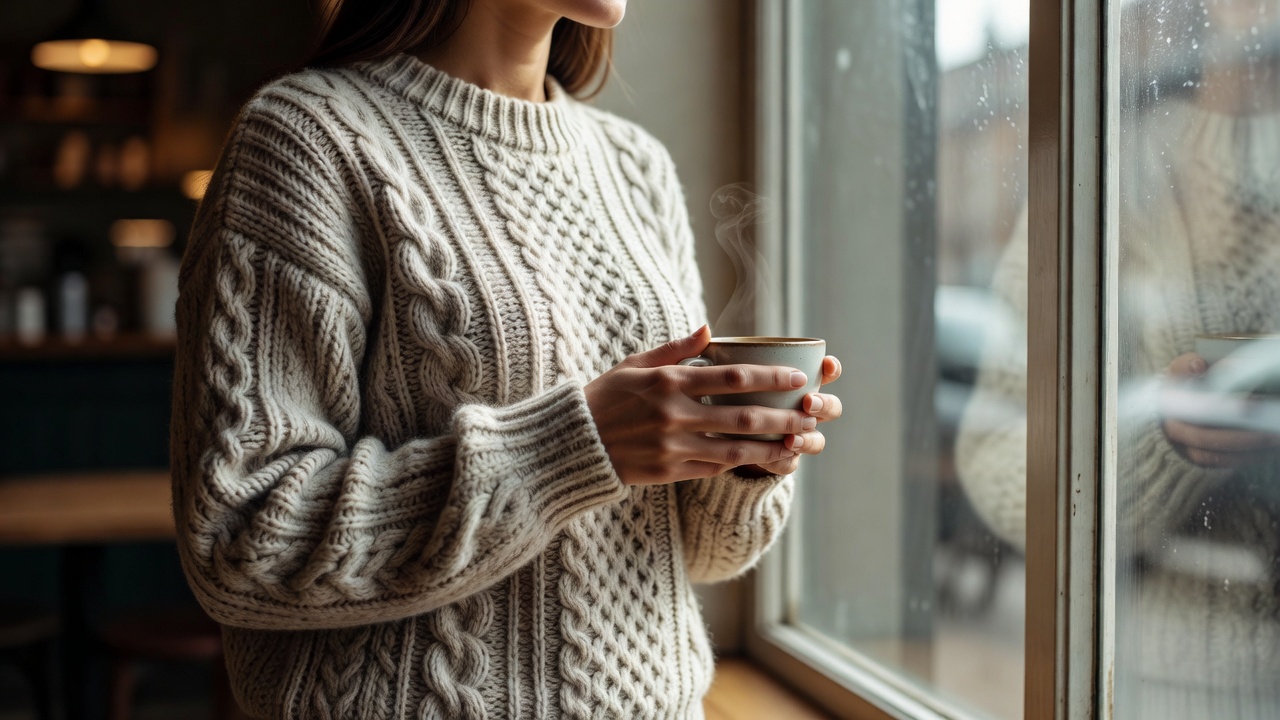
Wool fibres absorb a meaningful amount of moisture vapour before they feel damp, which helps them buffer the move from a cold platform to an overheated carriage. Fine merino — the kind used in thin knits and base layers — is soft enough to wear against the skin and naturally resists odour, so a merino tee or crew-neck can comfortably handle a long day and an evening without feeling stale.
Heavier woollens and boiled wools shed light rain well and keep their shape, which is why a wool overcoat remains the default winter commute layer in cities from Edinburgh to Milan. The trade-off is care: most wool prefers a cool wool cycle or hand wash and flat drying. The Woolmark logo you may see on labels is a quality certification for wool content, not a care instruction — always check the care symbols too.
Cotton: same fibre, many personalities
Cotton is the fibre most of us wear most often, but its behaviour depends almost entirely on how it is woven or knitted.
- Poplin is a tight plain weave: crisp, cool, and quick to crease. Great for a standing presentation, less great after an hour in a car.
- Oxford cloth has a slightly textured basket weave. It creases softly and looks better slightly lived-in, which suits café and remote days.
- Twill — as in chinos and denim — hides creases with its diagonal rib and handles abrasion from bags and bike seats.
- Jersey is knitted, so it stretches. It is the comfort champion for desk days, but lightweight jersey shows every bulge and can lose shape at the neckline.
If organic sourcing matters to you, the Global Organic Textile Standard (GOTS) is one of the more rigorous labels, covering both fibre and processing.
Linen: honest creases, real cooling
Linen is made from flax and wicks heat away from the body faster than most fabrics, which makes it the best choice for hot commutes and summer terraces. It also creases the moment you sit down. The useful mindset is to treat those creases as part of the fabric rather than a failure. In settings where you need to look pressed for a long stretch, a linen-cotton or linen-lyocell blend keeps some of the coolness with fewer wrinkles.
Lyocell and modal: drape for transitions
Lyocell — best known under Lenzing's TENCEL™ brand — is a cellulose fibre made from wood pulp using a solvent that is largely recovered and reused. It has a smooth, cool hand and a fluid drape, so wide trousers and relaxed shirts in lyocell look intentional instead of baggy. That makes it an excellent fabric for the desk-to-dinner transition. Modal is a close relative with a softer, more jersey-like feel, often used in tees and underwear.
Synthetics and blends: purpose over prejudice
Polyester and nylon get dismissed, but a small percentage in a blend can be genuinely useful: it adds crease resistance to trousers, shape retention to knits and abrasion resistance to coats. Fully synthetic shells are still the most practical choice for heavy rain and cycling. The questions to ask are whether the synthetic content solves a real problem, and whether you are comfortable with how it breathes in warm rooms.
Reading the label like a schedule
The care symbols on your label follow the ISO 3758 system: a washtub for washing, a triangle for bleaching, a square for drying, an iron for ironing and a circle for professional care. A garment that needs dry cleaning is effectively a garment with a running cost and a scheduling constraint, which is worth knowing before it becomes your Monday staple.
For outerwear and trousers that see heavy use, some brands quote Martindale abrasion results (measured under ISO 12947). Higher rub counts generally mean better resistance to pilling and wear from bags and seats.
Where to go next
Once you know how a fabric behaves, small details decide what it says. Continue with Small Details, Different Signals, or revisit how fabric weight changes proportion in Shape With a Purpose.